
IICRC-Certified Water Damage Editorial Reviewer · Georgia Field Experience
Published: May 12, 2026Last Updated: May 12, 20269 min readReviewed against IICRC S500 / S520 / S700
Water Damage vs Flood Insurance: What's Actually Covered?
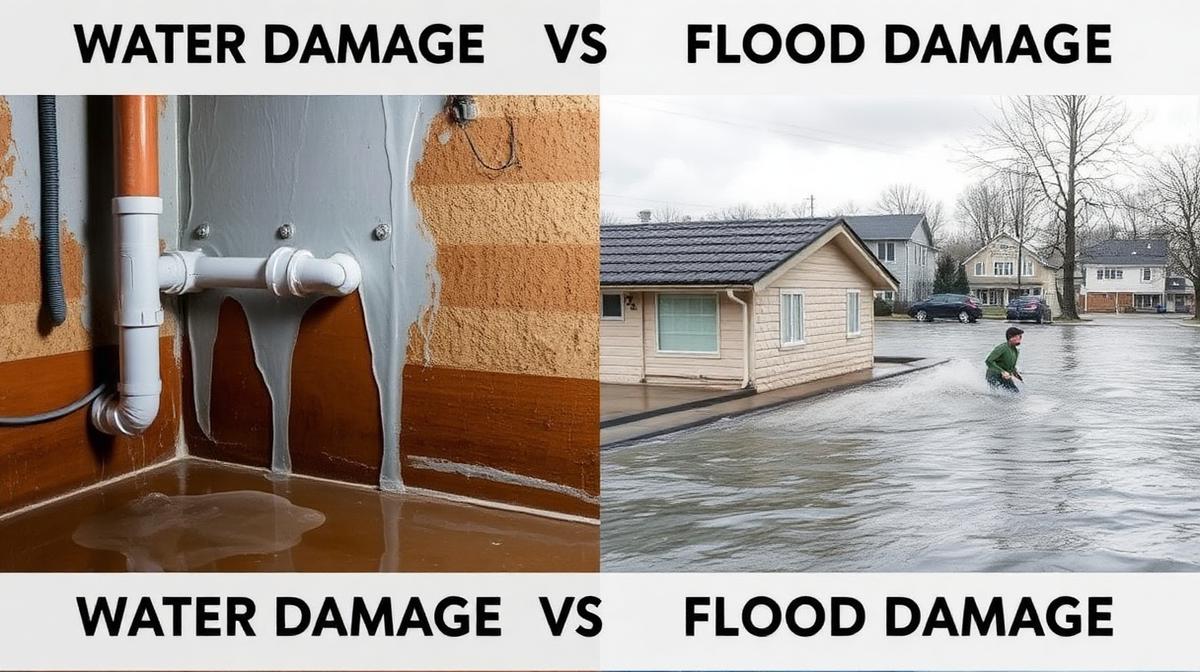
Standard homeowners policies cover water damage but exclude floods entirely. Side-by-side coverage breakdown so you know which policy pays.
- ›Water damage insurance (part of every standard homeowners policy) covers internal, sudden water losses — burst pipes, appliance leaks, ro…
- ›Flood is excluded from every standard homeowners policy in the U.S. because the risk profile is geographically concentrated and catastrop…
- ›About 25% of NFIP claims come from properties outside high-risk flood zones (Zone A or V). Urban drainage failures, unusual storms, and i…
- ›NFIP premiums in Georgia vary by zone, building type, and elevation. Typical ranges: $400–$700/year for Zone X (low risk), $1,200–$2,500/…
Two policies. Two completely different definitions of water. One pays for a burst pipe in your kitchen. The other pays for rising creek water in your living room. Most homeowners don't understand which is which until the claim is denied — and by then, the 30-day waiting period for flood insurance has already cost them everything.
This guide is a side-by-side coverage breakdown. No legalese, no policy citations — just what is actually covered, what is not, and which policy you need for which scenario.
Quick Answer — Water Damage vs Flood Insurance
Standard homeowners insurance covers internal, sudden water losses (burst pipes, appliance failures, roof leaks from storms). Flood insurance — a separate NFIP or private policy with a 30-day waiting period — covers external water entering from outside (surface runoff, storm surge, rising water). Both are necessary for full water-risk coverage.
The Source Test: Where Did the Water Come From?
Every water claim starts with this question. The answer determines which policy (if any) pays.
- From inside the home or roof: homeowners policy water damage coverage.
- From outside the home, entering at ground level or rising into the structure: flood insurance only.
- From below ground (groundwater seepage): usually flood insurance; some basement endorsements may apply.
- From the municipal sewer system (sewer backup): requires sewer-backup endorsement on homeowners policy.
Side-by-Side: What Each Policy Covers
Standard Homeowners Insurance — Water Damage Coverage
Covered:
- Burst supply lines (washing machine, ice maker, toilet, sink)
- Appliance failures (dishwasher, water heater, HVAC condensate)
- Roof leaks from storm damage (wind-created openings)
- Frozen pipe ruptures (in heated portions of the home)
- Accidental discharge from plumbing systems
- Hidden leaks behind walls (if sudden, not gradual)
Not covered:
- Any external flooding
- Groundwater seepage
- Gradual leaks (more than 14 days of slow damage typically)
- Maintenance-related failures
- Sewer backup (without endorsement)
- Mold (limited coverage, typically $5,000–$10,000 cap unless caused by covered loss)
NFIP Flood Insurance
Covered:
- Surface water flooding from rain or runoff
- Storm surge from hurricanes or tropical storms
- River or stream overflow
- Mudflow from heavy rain
- Building structure damage (up to $250,000)
- Contents damage if separately purchased (up to $100,000)
Not covered:
- Damage from sewer backup not caused by flooding
- Loss of use / additional living expenses
- Cash, precious metals, valuable papers
- Outdoor property (pools, fences, landscaping)
- Basement contents beyond limited categories (washer/dryer, freezer, HVAC)
- Vehicles (separate auto policy comprehensive coverage)

The Three Scenarios Every Georgia Homeowner Should Game-Plan
Scenario A: Burst Pipe in the Kitchen
Source: internal supply line failure. Coverage: standard homeowners. Typical payout: $5,000–$25,000 minus deductible. Documentation needed: photo of broken pipe, restoration scope, moisture readings.
Scenario B: Spring Storm Floods the Basement
Source: external surface water through foundation. Coverage: NFIP flood only. Without flood insurance: $0 coverage, full out-of-pocket loss. Read about Georgia spring storm basement flooding.
Scenario C: Sewer Backup Through Floor Drain
Source: municipal sewer overload. Coverage: requires sewer-backup endorsement on homeowners policy. Without endorsement: $0 coverage. Typical cleanup: $8,000–$25,000.
The 30-Day Waiting Period Trap
NFIP flood insurance has a federally-mandated 30-day waiting period from purchase to effective date. You cannot buy a policy when a storm is in the forecast. The waiting period exists to prevent adverse selection — homeowners only buying coverage when a storm is imminent. The lesson: buy flood insurance well before you need it, and renew it on time every year.
What Atlanta Homeowners Should Carry
A common recommendation for residential properties in the metro:
- Standard homeowners HO-3 policy with adequate dwelling and contents limits
- Sewer-backup endorsement ($50–$150/year)
- NFIP flood policy — even in Zone X, the premium is typically under $700/year
- Service line coverage if not already included ($30–$60/year, covers underground supply line replacement)
- Increased mold coverage if available
Total additional cost over a standard policy: typically $700–$1,200/year. Total potential coverage gap closed: $250,000+ on a single flood event.
Water or flood damage right now?
Call listed contractors directly and ask about water-damage cleanup, flood-damage documentation, NFIP experience, and payment terms.
The Line That Decides Coverage
Insurance treats water based on where it came from and how it arrived, not what it looks like once it's in your living room. The technical line: if the water touched the ground before it entered the home, it's flood. If it never touched the ground — pipe burst, roof leak, appliance failure, sewer backup from inside the home — it's water damage under your homeowners policy. That single distinction decides whether you file with your homeowners carrier or with FEMA's National Flood Insurance Program.
What Homeowners Insurance Covers
- Burst pipes, supply line failures, frozen line breaks
- Appliance failures — water heater, dishwasher, washing machine, ice maker
- Sudden roof leaks from storm damage (if the roof was in good condition)
- Toilet overflows from interior plumbing
- HVAC condensate line backups
What Homeowners Insurance Does Not Cover
- Any water that entered from outside at ground level — by definition, flood
- Sewer backup unless you carry a specific endorsement (typically $50–$150/year extra)
- Sump pump failure unless covered by endorsement
- Groundwater seepage through foundation walls — exclusion in virtually every policy
- Long-term leaks the homeowner could reasonably have noticed
What NFIP Flood Insurance Covers
Flood insurance is its own policy, issued by FEMA or by private insurers writing on NFIP-equivalent forms. Building coverage runs to $250,000 for the structure, $100,000 for contents. There is a 30-day waiting period before a new flood policy takes effect — which is why "I'll buy it when a hurricane is coming" doesn't work.
The Atlanta-Specific Reality
Most of metro Atlanta is not in a FEMA Special Flood Hazard Area, so mortgage lenders don't require flood insurance. That gives homeowners a false sense of safety. Flash flooding in Cobb, Gwinnett, and Fulton counties regularly damages homes outside the mapped flood zone — and none of that damage is covered without an NFIP policy. Outside the mapped zone, flood coverage often costs under $500/year. Skipping it is one of the most expensive savings decisions a homeowner can make.
Related Reading
Why Georgia insurance treats them differently · Why claims get denied · Flash flooding preparation.
Frequently Asked Questions
What is the difference between water damage and flood damage insurance?
Water damage insurance (part of every standard homeowners policy) covers internal, sudden water losses — burst pipes, appliance leaks, roof leaks from storms. Flood insurance (separate NFIP or private policy) covers external water that enters from outside as surface runoff, storm surge, or rising water. They cover completely different perils.
Why doesn't homeowners insurance cover flooding?
Flood is excluded from every standard homeowners policy in the U.S. because the risk profile is geographically concentrated and catastrophic — making it commercially uninsurable through private carriers without specific underwriting. Congress created the NFIP in 1968 to fill that gap with federally-backed coverage.
Do I need flood insurance if I'm not in a flood zone?
About 25% of NFIP claims come from properties outside high-risk flood zones (Zone A or V). Urban drainage failures, unusual storms, and infrastructure failures cause flooding in 'low-risk' areas regularly. Flood insurance for low-risk zones is significantly cheaper — typically $400–$700/year.
How much does flood insurance cost in Georgia?
NFIP premiums in Georgia vary by zone, building type, and elevation. Typical ranges: $400–$700/year for Zone X (low risk), $1,200–$2,500/year for Zone A (moderate risk), $2,500–$5,000+/year for Zone V (coastal high risk). Newer Risk Rating 2.0 prices reflect actual property-specific risk.
Does flood insurance cover everything in my home?
NFIP coverage has two parts: building coverage (up to $250,000) for structural elements and contents coverage (up to $100,000) which must be purchased separately. Some items like cash, precious metals, and outdoor property are excluded. Basements have limited contents coverage.
Related Articles You May Find Helpful

Compare water damage contractors near you
Need Help Right Now?
Phone: (470) 398-4095
✓ Directory help for Georgia homeowners
✓ Compare local water-damage contractors
✓ Contractor phones stay contractor-owned
EmesticaCure is a water damage contractor directory. Browse contractors or call (470) 398-4095 for help finding one.