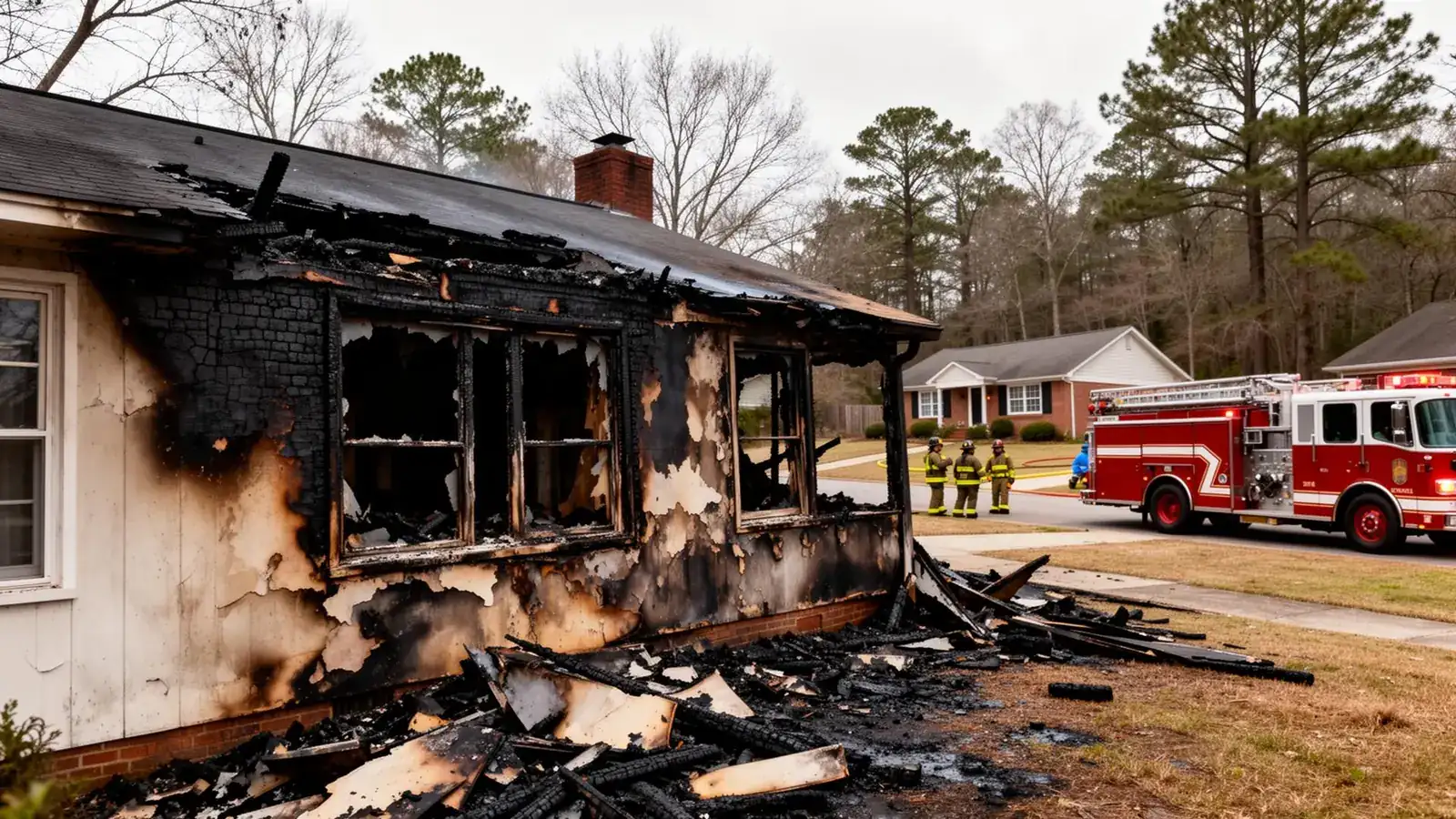
The fire is out. Now comes the part nobody warned you about.
When the trucks leave, you're standing in a house that smells like smoke, dripping with water, and covered in black residue that's already eating into every surface it touched. That's the moment we exist for.
Fire damage restoration is the professional process of cleaning, deodorizing, and rebuilding a property after fire, smoke, soot, and firefighting water damage. It is structural, environmental, and chemical remediation all at once — and it must start within 24–72 hours before acidic soot permanently bonds to surfaces. EmesticaCure dispatches a licensed Georgia crew within 30 minutes, 24/7.
- →Soot is acidic — etches metal and glass permanently in 48 hours
- →Smoke travels through HVAC into rooms the fire never reached
- →Firefighting water = mold within 24 hours in Georgia humidity
- →Board-up · soot removal · thermal fogging · HVAC decontamination
- →Direct billing: State Farm, USAA, Allstate, Farmers, GA Farm Bureau
- →One contractor: stabilization through full Georgia-code rebuild
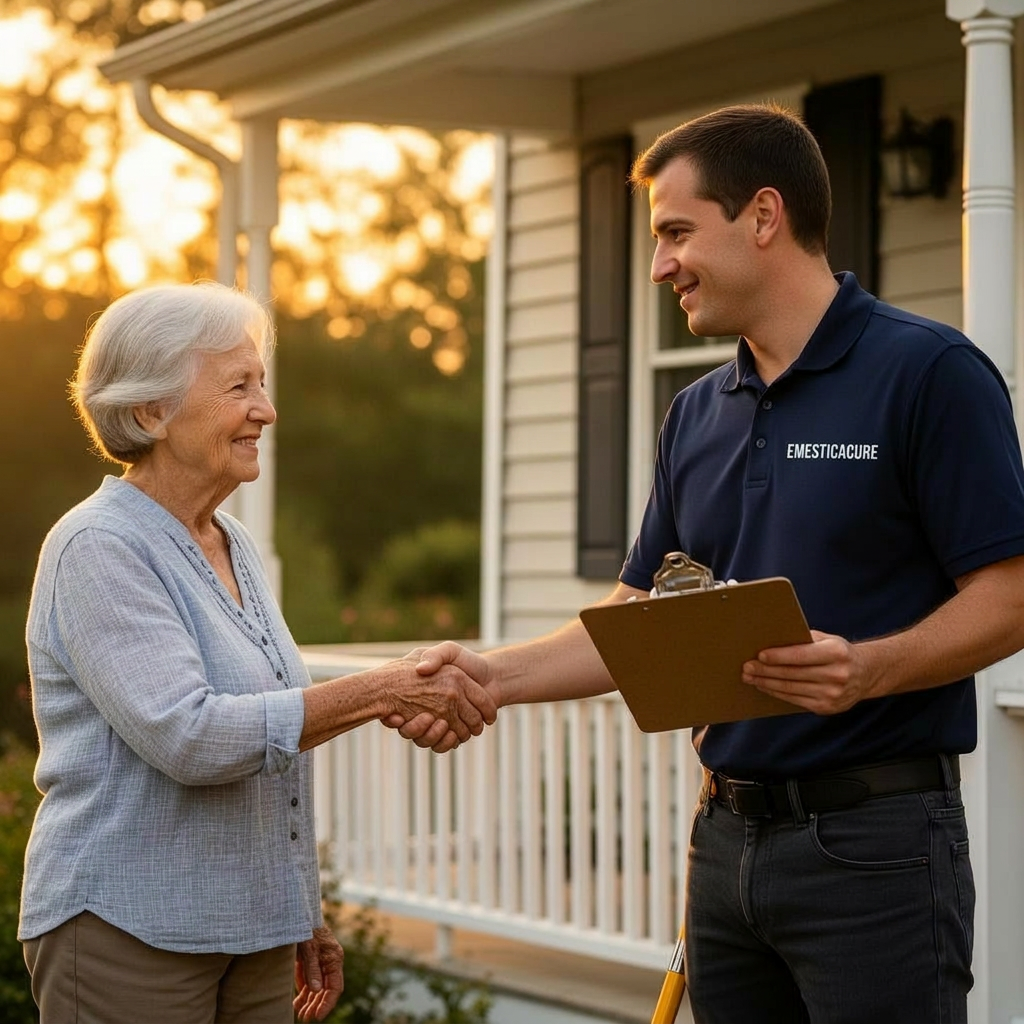
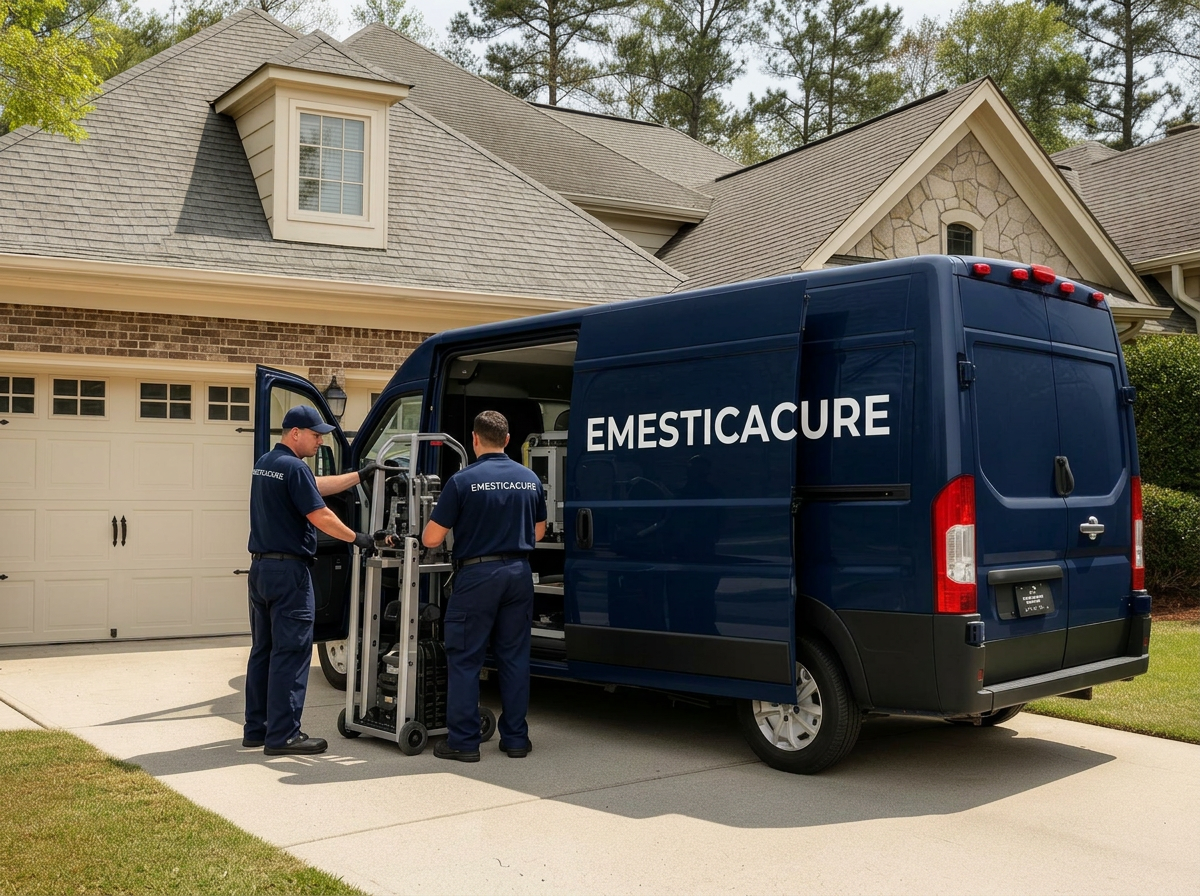
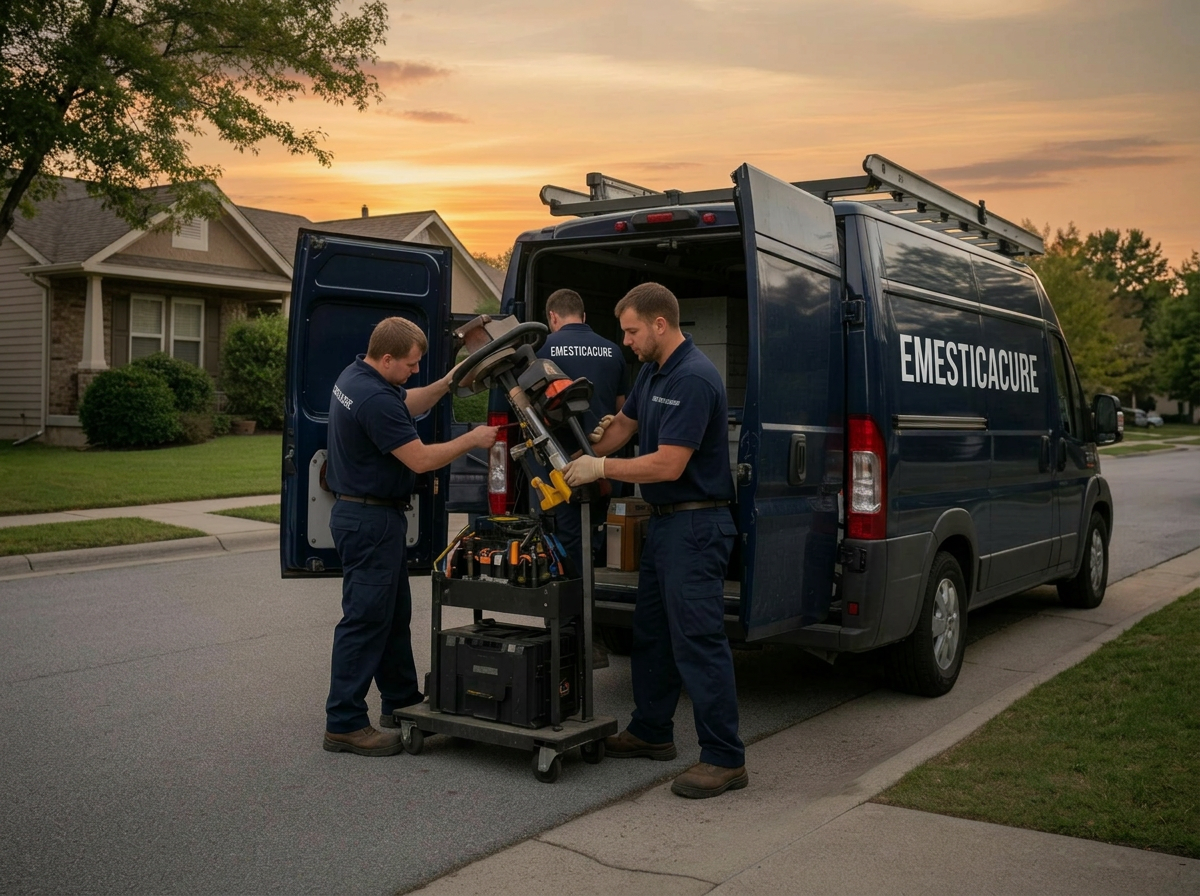
Our Fire & Smoke Restoration Crew On the Job
Technicians performing board-up, soot cleanup, thermal fogging and full fire restoration across Georgia. 24/7 — (470) 398-4095.
Fire damage restoration is the professional process of cleaning, repairing, and rebuilding a property after fire, smoke, soot, and firefighting water damage. It is not the same as a cleanup. It is structural, environmental, and chemical remediation all at once — and it starts the moment the fire department releases the scene.
Most Georgia homeowners don't realize a house fire is actually three problems stacked on top of each other. The flames are problem one — but they're usually the smallest. Smoke is problem two, and it travels through HVAC ducts and wall cavities into rooms that never saw a single flame. Firefighting water is problem three, and in Georgia's humidity it becomes a mold problem inside 24 to 48 hours. The first 72 hours after a fire decide how much of your home is recoverable. After that, acidic soot has bonded permanently to surfaces, smoke odor has saturated framing, and water has begun warping subfloor. That's why we move fast.
What Does Fire Damage Restoration Involve?
Fire damage restoration involves emergency stabilization, soot and smoke removal, firefighting water extraction, structural drying, odor neutralization, selective demolition, and full reconstruction of the affected property. It's the entire arc from the night of the fire to handing you back keys to a livable home.
The reason it takes more than cleaning is chemistry. Soot is acidic — measured around pH 2 to 4 depending on what burned — and it bonds permanently to finishes within 48 hours. Wipe it with a regular cloth and you grind it deeper into the surface. Synthetic materials like vinyl, plastics, and modern furniture release toxic compounds when burned, including hydrogen cyanide and aldehydes, that settle into drywall paper and HVAC components.
Smoke is worse than most people think. It travels with airflow, which means a kitchen fire in Cobb County can deposit soot on light fixtures in a bedroom at the far end of the house. If the HVAC was running during the fire, every supply vent in the home distributed smoke particulate. The smell doesn't fade — it lives in insulation, drywall, framing, and ductwork until it's actively removed.
Then there's the firefighting water. Fire departments use thousands of gallons, and almost none of it evaporates on its own — especially in a sealed-up Georgia home in July. Within 24 to 48 hours, mold colonies start forming on saturated drywall, baseboards, and subfloor. Drying out a fire-damaged structure is part of fire damage restoration, not a separate job, because the fire caused the water.
How We Restore Fire-Damaged Properties in Georgia
Seven phases, in the order they actually happen on a Georgia fire job.
Emergency Stabilization and Board-Up
Within hours of your call, we secure the structure so weather, animals, and looters can't make a bad situation worse.
Broken windows get boarded, the roof gets tarped where flames or firefighters opened it up, and we shut down any utility risk still active. In Georgia, this matters more than people think — a single thunderstorm rolling through Cobb or Cherokee County on a tarped roof can double your loss overnight. Georgia law lets us perform this emergency work before the adjuster ever sets foot on the property.
Damage Assessment and Insurance Documentation
We walk the property with you, photograph everything, and build the loss file your insurance adjuster will work from.
Every room gets documented — char patterns, smoke lines, soot deposits on HVAC vents, water saturation in flooring. We catalogue contents room by room. Most Georgia homeowners don't realize the burden of proof sits with them; a sloppy file gets a low settlement. Our reports go directly to State Farm, Allstate, USAA, Farmers, Nationwide, and Georgia Farm Bureau adjusters in the format they're used to reading.
Firefighting Water Extraction and Structural Drying
Before we touch soot, we pull the water out — because in Georgia humidity, mold colonies start forming in 24 to 48 hours.
Truck-mounted extractors pull standing water from flooring and subfloor. Commercial-grade dehumidifiers and air movers run continuously, with moisture readings logged daily. Summer in the metro can sit at 80% humidity outside, which means a wet wall cavity becomes a mold problem fast. This phase is part of fire damage restoration — not a separate service — because firefighting water is part of what the fire caused.
Smoke and Soot Removal
Soot is acidic and bonds permanently to surfaces within 48 hours, so this work starts the moment drying allows.
Different soot needs different cleaning — protein soot from a kitchen fire is nearly invisible and brutally hard to smell out, while synthetic soot from burning plastics is sticky, black, and toxic. We use chemical sponges on porous surfaces, alkaline degreasers on grease residue, HEPA vacuuming on settled particulate, and full HVAC decontamination so smoke doesn't keep recirculating through rooms the fire never touched.
Structural Cleaning and Deodorization
Smoke odor isn't surface-level — it's embedded in framing, drywall paper, and insulation, and it has to be neutralized at the source.
We seal salvageable framing, run thermal fogging to chase odor molecules into the same voids the smoke reached, and deploy ozone or hydroxyl treatment depending on whether the home is occupied. HEPA air scrubbing runs the entire time. If your house still smells like smoke six months after a quick wipe-down, this is the step that got skipped.
Selective Demolition and Reconstruction
Anything that can't be saved comes out; anything that can be saved gets rebuilt to current Georgia building code.
Heat-warped framing, smoke-saturated drywall, charred subfloor, melted wiring — out. Then drywall, insulation, flooring, paint, trim, cabinets, and fixtures go back in. We pull the permits with the local county, schedule inspections, and coordinate with your adjuster so supplements get approved before they hold up the rebuild.
Air Quality Testing and Final Inspection
Before we hand the house back, we test the air and walk every room with you — not just to sign off, but so you can actually sleep there.
Third-party indoor air quality testing confirms soot particulate is back to normal residential levels. We walk the entire property with you, check every detail, and don't close the job until you'd be comfortable letting your kids sleep in the rooms we worked on.
Does Homeowners Insurance Cover Fire Damage Restoration?
Yes — almost universally. Standard Georgia homeowners policies cover fire damage restoration, including the structure, smoke damage, firefighting water damage, and temporary housing under Additional Living Expenses (ALE) coverage.
In Georgia, your dwelling coverage pays to rebuild the physical structure. Personal property coverage pays to clean or replace your belongings — clothing, electronics, furniture, the contents of your kitchen. ALE coverage pays for a hotel, rental home, restaurant meals beyond your normal grocery budget, even pet boarding if you can't stay in the house. Most homeowners don't know ALE exists until we tell them.
Georgia insurance law also permits emergency authorization — meaning you can have a licensed restoration contractor like EmesticaCure start board-up, water extraction, and emergency mitigation before your adjuster ever walks the property. Waiting for adjuster approval to start emergency work usually causes more damage than the original fire.
We bill carriers directly: State Farm, Allstate, USAA, Farmers, Nationwide, Georgia Farm Bureau, Travelers, Liberty Mutual, and Progressive. We've worked with adjusters from every one of them across Cobb, DeKalb, Fulton, Cherokee, Gwinnett, and Forsyth counties. The documentation goes in the format their software expects, supplements get filed cleanly, and you don't get caught between the contractor and the carrier.
How Long Does Fire Damage Restoration Take?
Fire damage restoration in Georgia typically takes anywhere from 3 days for minor smoke events to 6 months for total losses, depending on the scope of damage and how fast your insurance adjuster moves.
Soot removal, deodorization, HVAC cleaning.
Selective demo and rebuild of affected rooms.
Multiple rooms, framing replacement, full reconstruction.
Down to studs or rebuild from foundation.
The honest truth: in most Georgia fire jobs, the insurance adjuster's response speed affects the timeline more than the restoration crew's speed. That's why our direct relationships with State Farm, Allstate, USAA, Farmers, Nationwide, and Georgia Farm Bureau matter. When supplements get filed cleanly and documentation lands the way their adjusters expect it, approvals move in days instead of weeks.
Fire Damage Scenarios We've Handled Across Georgia
Midnight kitchen fire — Cobb County family home
A grease fire on the stovetop spread to the cabinets above before the homeowner could smother it. Fire department doused the kitchen and stopped the flames at the wall, but smoke had already pushed through the HVAC into every bedroom. We were on site in 38 minutes. Within the first 12 hours we'd boarded up the kitchen window, extracted firefighting water from the hardwood floors, and sealed the HVAC return to stop further smoke spread. Soot removal across the home took 9 days. Kitchen rebuild — cabinets, countertops, drywall, ceiling — took another 4 weeks. State Farm settled the supplement on the second submission. Family was back home in 6 weeks.
Electrical attic fire — DeKalb County
A failed junction box ignited blown-in insulation in the attic. The fire stayed mostly in the attic, but with the HVAC running on a warm Georgia evening, smoke distributed through every ceiling vent in the home. The visible damage looked minimal. The smell was everywhere. We removed and replaced all attic insulation, decontaminated the entire HVAC system including the air handler, ran thermal fogging through all three floors, and sealed structural framing where smoke had penetrated. Homeowner thought it was a 2-week job. It was 5 weeks because the smoke saturation went deeper than the visible damage suggested. Allstate paid in full.
Commercial kitchen fire — Fulton County, off Peachtree
A small restaurant lost its hood suppression system during a deep-fryer flare-up. Flames stayed contained to the cookline but grease smoke coated the entire dining room — booths, ceiling tiles, light fixtures, the bar. The owner needed to reopen fast. We mobilized a full crew that night, cleaned and decontaminated the kitchen, replaced ceiling tiles in the dining room, restored the hood system, and had the health inspector back through in 12 days. Insurance covered loss of income under business interruption coverage.
Can I Stay in My Home During Fire Damage Restoration?
It depends on the scope. For minor smoke events, staying in the home is often possible with HEPA air scrubbers running. For any job involving significant soot, structural work, or ozone treatment, we recommend temporary housing — and it's almost always covered by your insurance under ALE.
The safety concerns are real. Acid soot particles are toxic when inhaled, especially for children, elderly family members, and anyone with asthma or cardiovascular conditions. Structural work creates dust hazards. Ozone treatment requires the home to be unoccupied entirely — humans, pets, and houseplants — for the duration of the cycle.
We'll tell you straight on the first walk-through whether the home is safe to occupy during the work. If it isn't, we help you file the ALE claim with your carrier so a hotel or rental home is paid for from day one.
What To Do Immediately After a House Fire in Georgia
If you're reading this in the first hours after a fire, here's the exact sequence — in the order it should happen.
- 1Do not re-enter until the fire marshal clears it.
Structures stay dangerous even after flames are out — hidden hot spots, weakened framing, toxic air. Wait for the official all-clear, no matter how stable the building looks.
- 2Call your insurance carrier within 24 hours.
Open the claim, get a claim number, ask for your adjuster's contact and your ALE limits. This call starts your coverage clock and unlocks temporary housing reimbursement.
- 3Document everything with photos and video before any cleanup.
Walk every room. Photograph the damage, the contents, the soot patterns, the water saturation. This footage is the foundation of your claim — once cleanup starts, you can't recreate it.
- 4Authorize emergency stabilization.
Georgia law allows licensed restoration contractors to begin board-up, water extraction, and emergency mitigation before your adjuster arrives. Delaying this step is what turns recoverable damage into total loss.
- 5Call a licensed restoration contractor — not a handyman.
Fire damage restoration requires IICRC certification, specialized equipment, and direct insurance billing experience. A handyman with a shop vac will cost you the claim.
Fire Damage Restoration — Common Questions
Fire Damage Restoration Across Georgia
Crews stationed across metro Atlanta, dispatched statewide 24/7.
Fire & smoke damage pages by city
If you're standing in a house that smells like smoke right now, you don't need a marketing pitch. You need somebody who's done this before, who answers the phone, and who knows exactly what comes next. That's us. We're licensed, IICRC certified, and we've handled fires in homes from Marietta to Macon — kitchen fires, attic fires, electrical fires, the ones that started small and the ones that took half the house.
You don't have to figure this out alone. We'll walk the property with you, talk to your adjuster, board it up tonight, and start the restoration tomorrow. Whatever it takes to get your home back.
We answer every time.